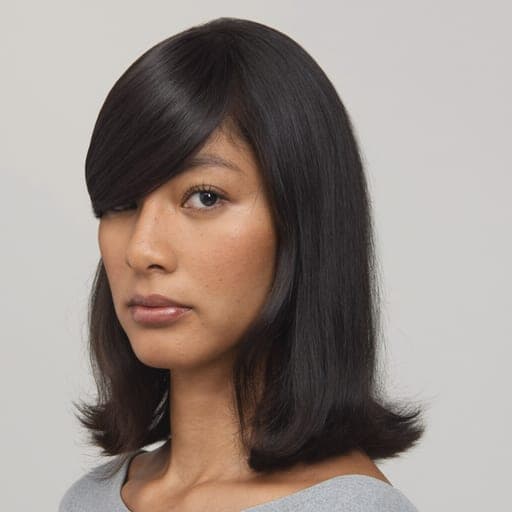
LongAI illustrationCurtain Bangs
A long fringe parted in the middle and swept outward, blending into the length at the cheekbone.
Why it works: Covers width at the forehead and shortens a long face without the commitment of a blunt fringe.
Hairstyle guide
A heart-shaped face is widest at the forehead and cheekbones and tapers to a narrow, often pointed chin. A widow's peak is common and is part of what creates the outline.
Everything below follows one idea: the top of the face is already the widest part, so add nothing there and build fullness lower down instead. Once you have that, most decisions make themselves.
It is worth saying that the chin is not a flaw to be hidden. A tapered jaw is what gives this shape its definition in photographs, and the aim is balance rather than disguise — enough weight at the jaw that the face reads as one shape rather than two halves.
Balance the top against the bottom — reduce visual width at the forehead, add fullness around the jaw.
Piling volume on top. Big roots, height at the crown and slicked-back styles all widen or expose the part of the face that is already widest, and leave the narrow chin looking narrower by comparison.
Each of these carries the reason it works and what it costs you in upkeep — the half of the decision that gets left out most often.
LongAI illustrationA long fringe parted in the middle and swept outward, blending into the length at the cheekbone.
Why it works: Covers width at the forehead and shortens a long face without the commitment of a blunt fringe.
Mid-lengthAI illustrationA fringe cut on an angle and worn across the forehead to one side.
Why it works: The diagonal softens angular corners and hides forehead width where the face is widest up top.
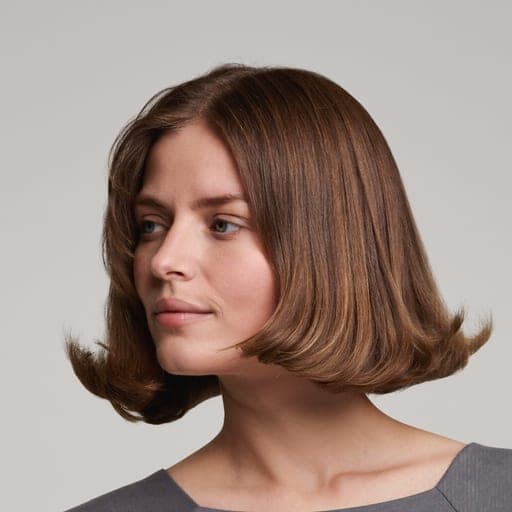
Mid-lengthAI illustrationA long bob cut to one length, ending somewhere between the jaw and the collarbone.
Why it works: The blunt weight at the bottom builds width exactly where a heart-shaped face narrows.
ShortAI illustrationA classic bob finishing right at the chin.
Why it works: Adds width at the sides at exactly the height a long or narrow-jawed face needs it.
ShortAI illustrationA jaw-length bob with soft internal layers and a rounded, bouncy finish.
Why it works: Volume at the jaw fills out a narrow chin and interrupts a long vertical line.
LongAI illustrationMid-length or long hair waved loosely, with the bend starting below the ear.
Why it works: Curves are the direct answer to straight lines — a hard jaw, a long cheek, a sharp cheekbone.
LongAI illustrationAny length, parted far to one side so the hair falls asymmetrically across the forehead.
Why it works: An asymmetric line is the cheapest way to break up a symmetrical, wide or angular face.
LongAI illustrationLong, all one length, worn straight and smooth.
Why it works: An unbroken vertical line is the strongest lengthening tool available.
A fringe is genuinely useful here, because covering forehead width is half the job. A side-swept fringe is the reliable choice: it reduces the visible expanse and adds a diagonal at the same time.
Curtain bangs work well too and have the advantage of growing out gracefully into face-framing layers.
A widow's peak makes a blunt fringe difficult — the hair grows forward in the centre and pushes a straight line out of shape within days. Side-swept and curtain styles work with that growth pattern instead of against it.
These all do the same thing from different directions: they expose or widen the forehead, or they remove weight from the jaw. A very short pixie does both at once, which is why it is the hardest cut for this shape to carry.
Compare the width of your forehead to the width of your jaw. On a heart-shaped face the forehead is clearly the wider of the two, and the chin comes to a relatively narrow point.
If the widest point is the cheekbones rather than the forehead, and the forehead is narrow too, you are closer to a diamond — the advice overlaps but not entirely.
Or measure it from a photo — it takes a few seconds and runs entirely in your browser.
The same proportions decide your frames, and the answer is not always the same one: glasses for heart faces.
FAQ