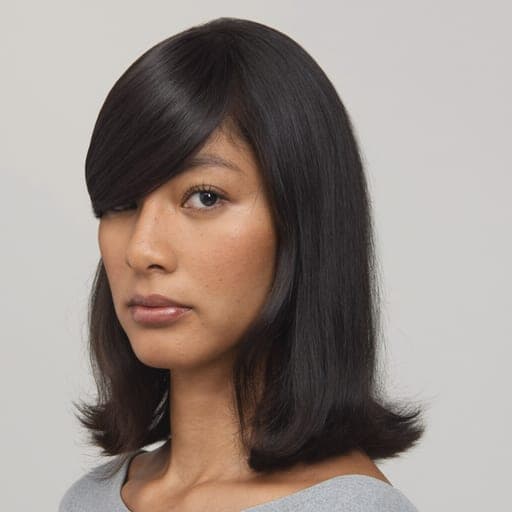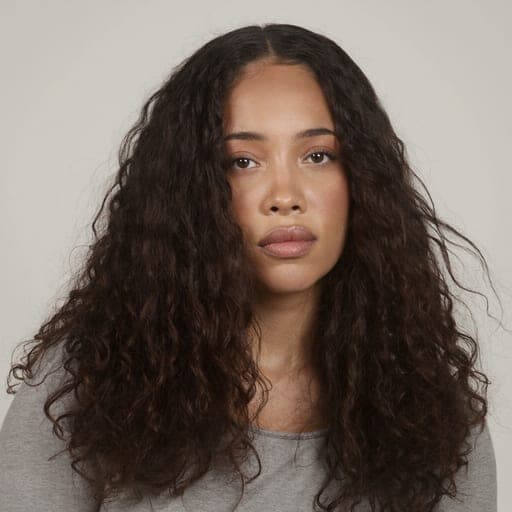
Hairstyle guide

Hairstyles for a Diamond Face

A diamond face is narrow at the forehead, widest at the cheekbones, and narrow again at the jaw. It is the least common of the six and the most often misidentified, usually as heart or oval.

Both the forehead and the jaw are narrow, so unlike every other shape here you are adding width in two places rather than reducing it in one. Once you see it that way, the recommendations stop looking contradictory.

That double task is also why generic advice fails this shape more than any other. Guidance written for a heart-shaped face tells you to reduce forehead width, which is the opposite of what you need, and guidance written for a round face tells you to narrow the sides, which sharpens the contrast you are trying to soften.

The aim

Add width where the face is narrow — forehead and jaw — so the cheekbones read as a highlight rather than the whole story.

The mistake to know about first

Pulling hair back tight. Slicked-back styles expose narrow temples and leave the cheekbones as the only wide point, which exaggerates the very contrast you are trying to balance.

8 cuts that suit a diamond face

Each of these carries the reason it works and what it costs you in upkeep — the half of the decision that gets left out most often.

A woman with long layers: Shoulder-length or longer, cut in graduated layers so the hair moves instead of hanging in one block.LongAI illustration

Long Layers

Shoulder-length or longer, cut in graduated layers so the hair moves instead of hanging in one block.

Why it works: The vertical line lengthens a round face, and the softness at the ends takes the edge off a strong jaw.

Low upkeepTrim every 10–12 weeks. Air-dries acceptably.

A woman with curtain bangs: A long fringe parted in the middle and swept outward, blending into the length at the cheekbone.LongAI illustration

Curtain Bangs

A long fringe parted in the middle and swept outward, blending into the length at the cheekbone.

Why it works: Covers width at the forehead and shortens a long face without the commitment of a blunt fringe.

Some upkeepFringe trim every 4–6 weeks; needs a round brush most mornings.
A woman with side-swept fringe: A fringe cut on an angle and worn across the forehead to one side.Mid-lengthAI illustration

Side-Swept Fringe

A fringe cut on an angle and worn across the forehead to one side.

Why it works: The diagonal softens angular corners and hides forehead width where the face is widest up top.

Some upkeepTrim every 4–6 weeks. Needs drying in the right direction.
A woman with chin-length bob: A classic bob finishing right at the chin.ShortAI illustration

Chin-Length Bob

A classic bob finishing right at the chin.

Why it works: Adds width at the sides at exactly the height a long or narrow-jawed face needs it.

Some upkeepTrim every 6–8 weeks.
A woman with italian bob: A jaw-length bob with soft internal layers and a rounded, bouncy finish.ShortAI illustration

Italian Bob

A jaw-length bob with soft internal layers and a rounded, bouncy finish.

Why it works: Volume at the jaw fills out a narrow chin and interrupts a long vertical line.

Some upkeepTrim every 6–8 weeks; wants a blow-dry to sit properly.
A woman with shoulder-length shag: Heavily layered and textured through the mid-lengths, usually with a fringe.Mid-lengthAI illustration

Shoulder-Length Shag

Heavily layered and textured through the mid-lengths, usually with a fringe.

Why it works: Texture in every direction breaks up straight edges and adds width where the face is narrow.

Low upkeepTrim every 10–12 weeks. Designed to look better unstyled.
A woman with soft waves: Mid-length or long hair waved loosely, with the bend starting below the ear.LongAI illustration

Soft Waves

Mid-length or long hair waved loosely, with the bend starting below the ear.

Why it works: Curves are the direct answer to straight lines — a hard jaw, a long cheek, a sharp cheekbone.

High upkeepThe cut is easy; the waves are a daily job unless your hair does it naturally.
A woman with bixie: Between a bob and a pixie — short, layered, with length left over the ears and at the nape.ShortAI illustration

Bixie

Between a bob and a pixie — short, layered, with length left over the ears and at the nape.

Why it works: The layers over the ears add width at the temples where a diamond face is narrowest.

Some upkeepTrim every 6 weeks.

Fringe and bangs for a diamond face

A fringe is one of the most effective tools for this shape, because the forehead is narrow and a fringe fills it out. Side-swept and curtain styles both work well.

Curtain bangs are particularly good: they add width at the temples while leaving the centre open, so the forehead reads fuller without looking covered.

Keep any fringe soft rather than heavy. A blunt fringe on a narrow forehead can look like it does not fit the face it is on.

What to think twice about

  • Slicked-back styles that expose the temples
  • Narrow styles pulled tight at the cheekbones
  • Flat centre parts

These narrow the face further at the two points that are already narrow, or pull tight across the cheekbones and emphasise the widest point. Both make the contrast between middle and ends more pronounced, which is the opposite of the goal.

How to tell if this is your shape

The widest point is the cheekbones — clearly wider than both the forehead and the jaw. That is the defining feature and the thing to check first.

Then separate it from heart. A heart-shaped face has a wide forehead; a diamond has a narrow one. If both your forehead and your jaw are narrower than your cheekbones, it is a diamond.

The other frequent mix-up is oval. An oval face also tapers gently, but its widest point is much less pronounced and its forehead is a little wider than its jaw rather than similar to it. If the cheekbones are the obvious standout feature, it is a diamond.

Or measure it from a photo — it takes a few seconds and runs entirely in your browser.

The same proportions decide your frames, and the answer is not always the same one: glasses for diamond faces.

FAQ

Common questions

How is a diamond face different from a heart-shaped one?
The forehead. Both narrow toward the chin, but a heart-shaped face is wide at the forehead while a diamond is narrow there. That changes the advice at the top of the face completely — heart shapes reduce forehead width, diamonds add it.
What length works best?
Chin length or a little below, with movement in it. That places fullness at the jaw where the face narrows. Shoulder-length shags work for the same reason, adding texture at both the cheek and the jaw.
Why do slicked-back styles look severe on me?
Because they strip width from the two narrowest parts of your face at once. Pulling hair tight flattens the temples and exposes a narrow forehead, leaving the cheekbones as the only wide point in the outline. A loose updo with pieces left down at the temples and jaw avoids that entirely.