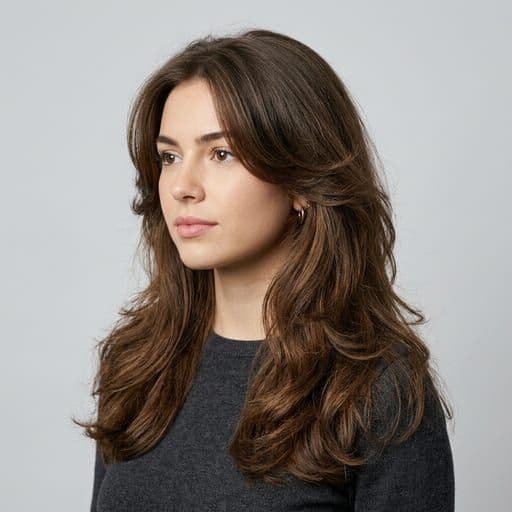
Hairstyle guide

Hairstyles for a Long Face

A long face, sometimes called oblong or rectangular, is noticeably longer than it is wide, with a long straight cheek line and a forehead, cheekbones and jaw of similar width. It is the shape most often confused with oval, and the two want quite different things.

The whole task is interrupting the vertical. A fringe does it instantly; width at the sides does the rest. There is no shape where a single decision changes the outcome as much as a fringe does here.

The aim

Interrupt the vertical line. A fringe shortens the face instantly; width at the sides does the rest.

The mistake to know about first

Very long, one-length, straight hair. It runs an unbroken vertical line from crown to below the shoulders and adds the full length of the hair to the apparent length of the face. It is the most common look for this shape and the least flattering.

8 cuts that suit an oblong face

Each of these carries the reason it works and what it costs you in upkeep — the half of the decision that gets left out most often.

A woman with face-framing layers: Long layers cut shorter around the face only, starting at or below the cheekbone.LongAI illustration

Face-Framing Layers

Long layers cut shorter around the face only, starting at or below the cheekbone.

Why it works: Diagonal lines across the cheek break up a square jaw and a long straight cheek line at once.

Some upkeepTrim every 8–10 weeks or the shortest pieces lose their shape.

A woman with curtain bangs: A long fringe parted in the middle and swept outward, blending into the length at the cheekbone.LongAI illustration

Curtain Bangs

A long fringe parted in the middle and swept outward, blending into the length at the cheekbone.

Why it works: Covers width at the forehead and shortens a long face without the commitment of a blunt fringe.

Some upkeepFringe trim every 4–6 weeks; needs a round brush most mornings.
A woman with full blunt fringe: A heavy fringe cut straight across at eyebrow level, full from temple to temple.Mid-lengthAI illustration

Full Blunt Fringe

A heavy fringe cut straight across at eyebrow level, full from temple to temple.

Why it works: Nothing shortens a long face faster: it removes the forehead from the equation entirely.

High upkeepTrim every 3–4 weeks and style daily — the least forgiving cut here.
A woman with chin-length bob: A classic bob finishing right at the chin.ShortAI illustration

Chin-Length Bob

A classic bob finishing right at the chin.

Why it works: Adds width at the sides at exactly the height a long or narrow-jawed face needs it.

Some upkeepTrim every 6–8 weeks.
A woman with italian bob: A jaw-length bob with soft internal layers and a rounded, bouncy finish.ShortAI illustration

Italian Bob

A jaw-length bob with soft internal layers and a rounded, bouncy finish.

Why it works: Volume at the jaw fills out a narrow chin and interrupts a long vertical line.

Some upkeepTrim every 6–8 weeks; wants a blow-dry to sit properly.
A woman with shoulder-length shag: Heavily layered and textured through the mid-lengths, usually with a fringe.Mid-lengthAI illustration

Shoulder-Length Shag

Heavily layered and textured through the mid-lengths, usually with a fringe.

Why it works: Texture in every direction breaks up straight edges and adds width where the face is narrow.

Low upkeepTrim every 10–12 weeks. Designed to look better unstyled.
A woman with butterfly cut: Long hair with two layer lengths — short face-framing pieces over long ends, so it reads as short and long at once.LongAI illustration

Butterfly Cut

Long hair with two layer lengths — short face-framing pieces over long ends, so it reads as short and long at once.

Why it works: The shorter top layers add width at the cheek while the length keeps the overall line vertical.

Some upkeepTrim every 8–10 weeks; needs volume at the roots to work.
A woman with soft waves: Mid-length or long hair waved loosely, with the bend starting below the ear.LongAI illustration

Soft Waves

Mid-length or long hair waved loosely, with the bend starting below the ear.

Why it works: Curves are the direct answer to straight lines — a hard jaw, a long cheek, a sharp cheekbone.

High upkeepThe cut is easy; the waves are a daily job unless your hair does it naturally.

Fringe and bangs for a long face

This is the one shape where a full blunt fringe is the strongest recommendation on the list. Cutting straight across at the brow removes the forehead from view and shortens the face immediately and dramatically.

If a blunt fringe is too much commitment — and it is high maintenance, needing a trim every three to four weeks — curtain bangs achieve a softer version of the same effect while covering some forehead height.

What does not work is a long side-sweep that leaves most of the forehead visible. It adds a diagonal without shortening anything.

What to think twice about

  • Very long, straight, one-length hair
  • Height stacked on the crown
  • Flat centre part with no volume

Each of these extends the vertical line or refuses to interrupt it. Height on the crown literally adds length; a flat centre part with no volume runs a straight line down the middle of an already long face; one-length long hair does both.

How to tell if this is your shape

Measure hairline to chin, and cheekbone to cheekbone. On a long face the length is substantially greater — noticeably more than the modest difference that marks an oval.

Then check the widths. If forehead, cheekbones and jaw are all about the same, and the cheek line between them looks straight rather than curved, that is oblong rather than oval.

Or measure it from a photo — it takes a few seconds and runs entirely in your browser.

The same proportions decide your frames, and the answer is not always the same one: glasses for oblong faces.

FAQ

Common questions

Do I have a long face or an oval face?
Both are longer than wide; oblong is more so. The reliable tell is the cheek line. An oval face curves gently from cheekbone to jaw, while a long face has a straight vertical stretch between them. If that section looks like a line rather than a curve, treat it as long.
Can I have long hair with a long face?
Yes, provided it is not left one length and straight. Waves starting below the ear add width, and a butterfly cut keeps overall length while placing shorter layers at the cheek. It is the flat unbroken vertical that is the problem, not the length itself.
Should I avoid a high ponytail?
It adds height above the crown, which extends the vertical. A low ponytail or a bun at the nape avoids that, and leaving a few pieces loose at the sides adds width where you want it.